
How Naples Soil Affects Your Concrete Foundation
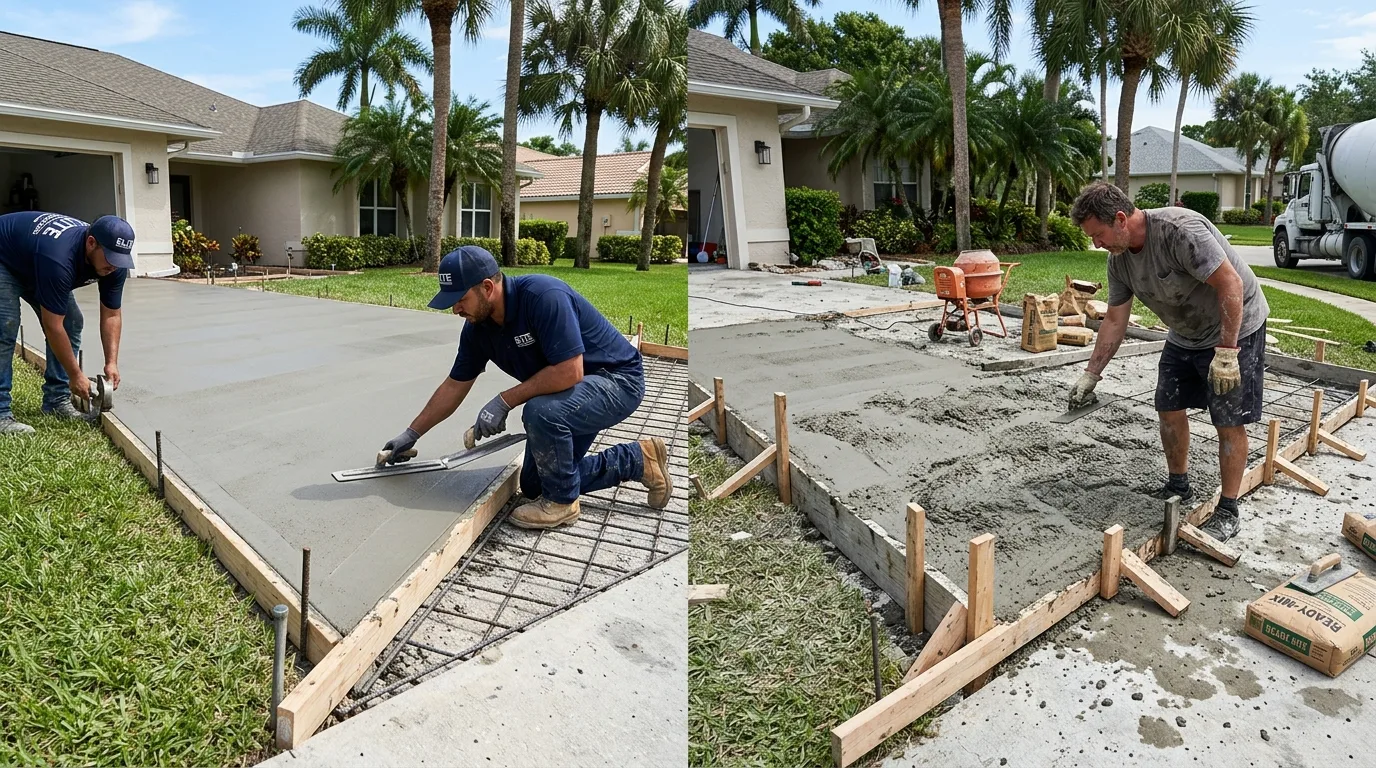
Every concrete slab in Naples sits on soil — and in Collier County, that soil is more variable and more challenging than most homeowners realize until they’re dealing with a cracked foundation or a settled driveway. The soil beneath your Naples home directly determines how your concrete performs, how long it lasts, and how much your base preparation costs. This post explains the soil types found across Naples and Collier County, how each one affects concrete, and what proper foundation and slab design looks like for each.
Naples Concrete Slab Estimates — Site-Specific Specifications
Naples Concrete Pros evaluates your site before specifying base depth. Call (888) 376-0955.
The Three Soil Types Affecting Naples Concrete
1. Expansive clay — The dominant soil type in much of inland Collier County, particularly in Golden Gate Estates, East Naples, and the areas east of Collier Boulevard. Clay is the most problematic soil for concrete foundations. When saturated during Naples’ June–September rainy season, clay expands volumetrically — creating uplift pressure beneath slabs and lateral pressure against foundation walls. When the dry season arrives and soil moisture drops, clay contracts and pulls away from the slab base, creating voids that allow concrete to flex under load and crack.
The seasonal cycle — wet season expansion, dry season contraction, wet season expansion again — is relentless. Every year, clay soil beneath inadequately prepared foundations applies stress that cumulates. This is why Golden Gate Estates has one of the highest concrete repair call rates in Collier County: the soil demands base preparation depths that contractors who learned their trade in other markets don’t automatically apply.
2. Sandy coastal soil — Common near the Gulf coast in Naples Park, Vanderbilt Beach corridor, and coastal sections of Marco Island. Sandy soil drains well and doesn’t generate the seasonal expansion pressure that clay does — a significant advantage for concrete performance. However, sandy soil requires proper compaction before base rock placement. Loose or poorly compacted sand shifts under load, particularly near street edges where traffic vibration is highest, creating uneven settlement beneath driveways and walkways.
Sandy coastal soil also has low bearing capacity without compaction — concrete slabs on poorly compacted sand are at risk of uniform settlement over time as the sand particles rearrange under load. The solution is thorough compaction testing and adequate base rock depth, which distributes loads over a wider area than sand alone can support.
3. Mixed and transitional profiles — Much of Naples proper — East Naples, the areas between downtown and Golden Gate, and mid-county communities like Lely Resort — have soil profiles that transition between sandy and clay-rich layers at varying depths. A site that shows sandy soil at the surface may have expansive clay starting 12–18 inches down, within the zone that concrete slab base preparation must address.
This is why site visits and soil assessment matter for Naples concrete work. A contractor who specifies the same base for every Naples property is almost certainly getting it wrong for some of them.
How Each Soil Type Changes Your Concrete Specification
On expansive clay (Golden Gate Estates, East Naples):
- Minimum 6 inches of compacted base rock, with 8 inches preferred for larger slabs
- Lime stabilization of clay subgrade where soil plasticity index is high (treats the clay chemically to reduce expansion potential)
- Wider vapor barrier specification to manage ground moisture from below
- Increased control joint frequency to manage cracking from soil movement
- Drainage planning that reduces moisture content variation beneath the slab
On sandy coastal soil (Naples Park, Vanderbilt Beach corridor):
- Compaction testing before base rock placement — don’t assume loose coastal sand is compacted
- Standard 4–6 inch base rock depth is adequate if compaction is verified
- Vapor barrier required to address ground moisture in coastal high-water-table areas
- Marine-grade sealer for properties within 500 feet of saltwater
- Enhanced reinforcement (epoxy-coated rebar) near saltwater and tidal influence zones
On mixed/transitional profiles (East Naples, Lely Resort area):
- Soil probe or investigation to determine clay layer depth before specifying base
- Conservative 6-inch base rock as default until soil profile is confirmed
- Vapor barrier per coastal proximity and water table elevation
- Standard reinforcement for inland properties, marine-grade for coastal transitions
Site-Specific Concrete Specs for Your Naples Property
We assess your soil before specifying base depth. Call Naples Concrete Pros at (888) 376-0955.
The High Water Table Problem in Naples
Naples’ water table is one of the highest in Florida. Coastal areas near the Gulf and areas near water bodies — Gordon River, Naples Bay, Wiggins Pass — have water tables at or near the surface during wet season. Low-lying inland areas in Collier County similarly have high water tables due to the flat terrain and concentrated rainfall.
A high water table creates two concrete problems: it saturates clay soils faster during wet season (amplifying the expansion problem), and it creates upward hydrostatic pressure beneath slabs. Concrete slabs near the water table without adequate vapor barriers experience moisture wicking from below, which causes:
- Floor covering failures — Adhesive-laid flooring (tile, vinyl, hardwood) delaminates when moisture vapor penetrates the slab from below
- Efflorescence — White mineral deposits on concrete surfaces caused by dissolved minerals in ground moisture
- Reinforcement corrosion — Ground moisture carries dissolved salts that accelerate corrosion of steel reinforcement, particularly near coastal areas
Vapor barrier specification for Naples slabs should be based on the site’s water table relationship. Properties in known high-water-table areas should use 10-mil or thicker vapor barriers and should incorporate perimeter drainage that reduces groundwater contact with the slab footprint.
Signs That Your Naples Foundation Has Soil Problems
Homeowners purchasing or improving Naples properties should watch for these indicators of underlying soil issues:
- Stair-step cracking in block walls or cracks that widen at one end and narrow at the other — these suggest differential settlement with one section of the foundation moving more than another
- Doors or windows that stick in humid conditions — a sign that the wall above them is deflecting as the foundation moves
- Visible gap between the slab and exterior walls — visible separation between the slab edge and adjoining structures indicates settlement or heaving
- Floor slope — walking across a room and noticing a significant slope where none should exist
- Repeated cracking after repair — cracks that reopen after being filled indicate ongoing movement that the fill alone can’t stop
Any of these signs warrant an investigation of both the surface damage and the underlying cause before committing to repair costs.
Practical Uses for This Information
- Property purchase in Naples — Before closing on a property with visible foundation cracking, have a contractor evaluate whether the cause is active (ongoing soil movement) or historical (one-time event now stable).
- New construction on clay soil — Insist on a soil investigation before accepting a base specification from any contractor. Blanket specifications on GGE clay without investigation are a warning sign.
- Driveway replacement in East Naples — Budget for soil investigation and potential lime treatment if your site has deep clay.
- Slab addition or room addition in high-water-table area — Discuss vapor barrier upgrades and perimeter drainage with your contractor before finalizing project scope.
- Coastal property in Naples Park — Confirm compaction testing is included in the project spec for all new concrete poured over sandy substrate.
Frequently Asked Questions
Do I need a soil test before pouring concrete in Naples?
Formal geotechnical soil testing (borings and lab analysis) is required for commercial structures and is recommended for large residential foundations. For driveways and patios, a visual site assessment and soil probe — which an experienced contractor can do during a site visit — is usually adequate to characterize the soil type and determine appropriate base depth. We assess every Naples concrete project site before finalizing specifications.
Can you fix soil problems after concrete is already poured?
Drainage problems beneath existing slabs can sometimes be addressed with French drains or perimeter drainage installation. Void formation beneath settled slabs can be filled through mudjacking or polyurethane foam injection. However, expansive clay problems beneath existing concrete are difficult to remediate without removing the slab. The easiest and most cost-effective time to address soil is before the concrete is poured.
Why do some Naples properties have worse soil problems than others?
Soil composition in Collier County varies significantly over short distances. Properties adjacent to each other can have different clay depths, drainage patterns, and water table relationships. Development history also matters — some areas were built on fill soil that hasn’t fully consolidated, which can cause ongoing settlement independent of native soil characteristics.
Naples Concrete — Site-Specific Engineering for Collier County Soils
Naples Concrete Pros assesses your site before specifying anything. Serving Naples, Golden Gate, and all of Collier County. Call (888) 376-0955.
Related: